

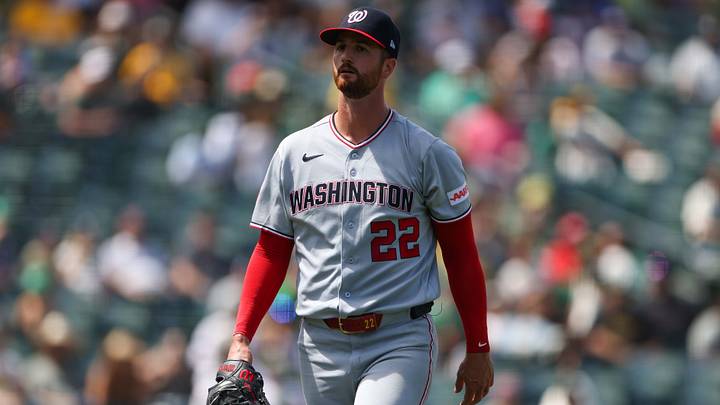
As I reflect on the 2026 Nationals season, I see it as a half-full glass. The team did not make the playoffs, but they accomplished great things. Specifically, they made great moves that panned out much better than expected.
The new brass hired had set out to develop young players and play moneyball of sorts. It wasn't the pure version of Billy Beane's Oakland Athletics, but the team did control the fifth-lowest payroll in 2026. Much like the Tampa Bay Rays, who had the third-lowest payroll in 2026, Paul Toboni had set out to maintain the philosophy of finding diamonds in the rough while risking hardly anything valuable.
The following three roster moves netted outperforming returns. This shows that this method of development and managerial strategy has worked and can continue to work if that payroll stays on a leash.
The Signing and Eventual Trade of Foster Griffin
Late in 2025, the Nationals signed Griffin to come back to MLB after a stint in Japan. It cost the franchise $5.5 million, a sound investment in Toboni's eyes and his scouts'.
Griffin had played a total of seven prior MLB games in 2020 and 2022 combined. His ERA was worse than 8.00, and ultimately, Griffin made a different move in his career, taking his talents across the Pacific.
In Japan, Griffin developed a new arsenal, featuring a slider, sinker, and sweeper. He brought his ERA to 1.62 in his 2025 season. The now-seven-pitch arsenal clearly caught the eye of Washington's scouts, and he was inked to a deal.
Griffin's season with the Nationals spanned 22 games before he was traded to the Cleveland Guardians, posting a 3.06 ERA and 1.08 WHIP. Despite his stellar output, the Nationals flipped Griffin, an upcoming free agent, for two top-30 organizational prospects, plus two more, for a total of four prospects.
The result? 17 wins and 5 losses in games Griffin started, plus four new prospects for virtually no cost by MLB standards.
The Trade for Curtis Mead
The Nationals traded a lower-end prospect, Boston Smith, to the Red Sox for Curtis Mead this past March. He was making less than $1 million, and the team preferred to sign another utility bat.
The expected result was hardly anything. Mead would provide depth as a hitter, which would likely not elevate a .250 batting average. Instead, they got much better.
Mead carded 87 games for the Nationals in 2026 before his trade, which brought Connelly Early to the Nationals. He recorded a 1.8 WAR, a .254 Batting Average, and an .852 OPS. For pennies, the move was great, later being flipped for a very high-upside young starter in Early as the Red Sox tried to mount their playoff run (which failed).
Claiming Joey Wiemer
His time in D.C. was limited, but memorable. The Rays claimed Wiemer in early January from the San Francisco Giants. Little was expected, but it was likely a high-upside move approved by the scouting department: a newer, more analytical product, similar to what the Rays have dominated in implementing for years.
Well, things went fantastic with Weimer early on for the lineup. In March/April, Weimer hit .327 and posted a .995 OPS. He was arguably the team's best batter at the time.
Wiemer eventually was sent down to Triple-A to make room for Dylan Crews' return. Struggles in the form of a sub-.200 Triple-A Batting Average sent his stock plummeting. The Nationals eventually waived Wiemer because no trade returns would be viable, and unlikely even available. But the team got fantastic baseball in the short little April romance Wiemer provided fans.
 Add us as a preferred source on Google