

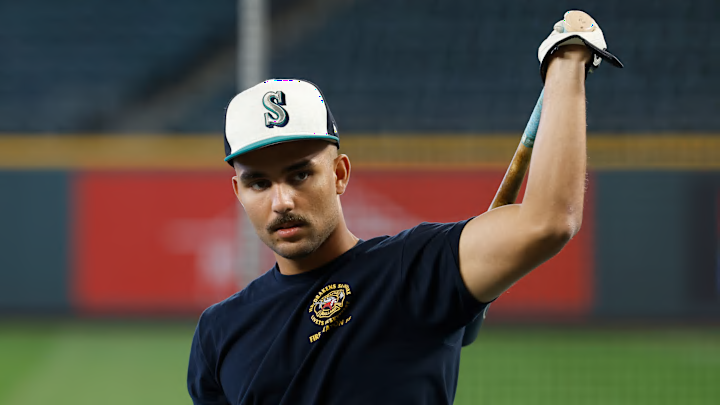
The Nationals made one of the boldest moves of the offseason: flipping a reliever for a top-50 prospect who could be the team’s catcher of the future.
Washington sent left-handed pitcher José A. Ferrer to the Mariners in exchange for catcher Harry Ford and right-handed pitcher Isaac Lyon. The first big swing by new president of baseball operations Paul Toboni, it turned heads across the league.
The Nationals had the worst catching production in all of baseball this season, with both Riley Adams and Keibert Ruiz struggling mightily. It stood out as the team’s most glaring weakness, and Toboni addressed it with a bold, outside-the-box maneuver for a potential franchise catcher.
This went beyond just another winter deal. It was a stunner. And the more you look at it, the more interesting it gets. Five fun facts show how significant the trade really was.
1. Harry Ford is now the Nationals’ No. 2 overall prospect
MLB Pipeline didn’t waste time updating the Nationals’ rankings. Harry Ford immediately slotted in at No. 2 in the system, right behind 17-year-old shortstop Eli Willits, the No. 1 overall pick in the 2025 MLB Draft. Ford now stands ahead of big-name arms like Travis Sykora and Jarlin Susana.
That placement speaks volumes about how Ford is viewed. Ford also ranks No. 42 on MLB Pipeline’s Top 100 and as the No. 3 catching prospect in all of baseball.
Ford emerged as the 12th overall pick in the 2021 MLB Draft out of North Cobb High School. In 2025, he slashed .283/.408/.460 with 16 home runs and 74 RBI at Triple-A Tacoma, drawing 74 walks to just 88 strikeouts. He even made a brief appearance in the big leagues in September. He also distinguished himself with selections to three consecutive Futures Games from 2023 through 2025. Listed at 5-foot-10, 200 pounds, he brings a compact, powerful build that plays both at the plate and behind it.
With Keibert Ruiz dealing with offensive challenges, defensive regression and ongoing durability issues, Ford should get a serious shot to seize the job in the near future.
2. He’s one of the fastest catchers baseball has seen in a long time
Ford isn’t just fast for a catcher, he’s fast, period. He’s swiped 92 bases in his minor league career, including 35 in 2024 while playing at Double-A Arkansas.
Scouts clocked him at 6.42 seconds in the 60-yard dash during a high school showcase, which is faster than many MLB outfielders. Most outlets grade Ford as a 60 runner, a mark that’s extremely rare for a catcher.
He’s even played center field and left field in the past, and his athleticism shows up behind the plate in the form of improved footwork, mobility and blocking. He served as a leadoff hitter during stretches in the minors, also unusual for a catcher. With his mix of speed and power, Ford threatens serious 20–20 potential. There simply aren’t many five-tool catchers in the game today. Ford’s skills and energy could make him one of the most exciting players on the Nationals roster.
3. He’s the face of British baseball and helped carry them to the World Baseball Classic
Ford hails from the Atlanta area, but both of his parents were born in the U.K., qualifying him to play for Team Great Britain.
He played a leading role in getting them to their first-ever World Baseball Classic in 2022, hitting three home runs, driving in eight and batting .455 during the qualifiers. He followed that up by batting .308 with two more homers in the 2023 WBC, then batted .429 with three long balls, 12 RBI and five stolen bases in the 2023 European Baseball Championship.
Ford has become the face of British baseball, not just because of his talent but because of the way he carries himself. He’s known as a leader, a strong teammate and someone who’s helped raise the program’s profile around the world.
4. The “other guy” in the trade, Isaac Lyon, is the son of a 12-year MLB reliever
The Nationals picked up more than just Ford in the trade. They also acquired right-handed pitcher Isaac Lyon, a 10th-round pick in 2025 out of Grand Canyon University. His numbers in Low-A weren’t great, but at just 21 years old, he offers some raw upside.
Lyon is the son of former big league reliever Brandon Lyon, who pitched 12 seasons in the majors from 2001-2013, appearing in 572 games with a 4.16 ERA and 79 saves. Isaac’s delivery resembles his father’s, and he projects as a bullpen arm down the road. The 6-foot-3, 200-pound righty has a fastball-slider combo that gives him something to build on. Growing up around MLB clubhouses gave him a front-row seat to the game and a unique perspective few young pitchers have.
He may have been a secondary piece in the deal, but he’s still a legit prospect with a big league pedigree and some intriguing traits to develop.
5. A top-50 prospect almost never gets traded for a reliever
It’s anomalous to see a team move a top-50 prospect for bullpen help, but that’s exactly what happened in the Harry Ford trade.
Ferrer, 25, had a 4.48 ERA this season. He’s shown promise, with strong peripherals (elite ground ball rate and low walk rate). But he’s still early in his career and has yet to prove himself over multiple full seasons. Ford, only 22, is younger and plays a premium position. That makes the swap remarkable. The fact that Washington was able to land not only Ford but also a lottery-ticket arm in Isaac Lyon makes the return even more impressive.
Seattle made the deal in part because they already have a franchise catcher in Cal Raleigh, who just became the first catcher in MLB history to hit 60 home runs in a single season. With Ford blocked, the Mariners chose to turn prospect capital into immediate bullpen help.
This is exactly the type of high-upside swing the Nationals need to be taking under Paul Toboni. If Ford develops the way they hope, this could go down as a major turning point in the rebuild.
Bonus Fact: This was a saxophone-for-saxophone trade
Although irrelevant to the deal, a coincidental fun fact is too good to ignore: both Harry Ford and José A. Ferrer play the saxophone.
Ferrer started learning and playing saxophone in the bullpen during the 2025 season, quickly gaining attention for it during games. Ford, meanwhile, picked up the instrument back in middle school and has mentioned it in interviews as one of his off-field hobbies.
It’s an unexpected twist that makes this deal not just a reliever-for-prospect swap, but a rare sax-for-sax trade.
 Add us as a preferred source on Google