

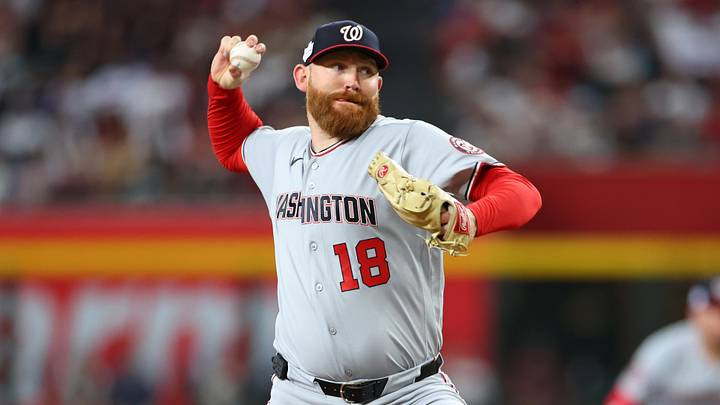
Baseball Savant just released new bat tracking data from Statcast. The new swing timing and miss distance leaderboards are exactly what they say on the tin: measuring which pitches get the best or worst swings, and which hitters can consistently get the best swings off on those pitches. Naturally, the first thing I did was look at how the Nationals stack up to the rest of the league. The signs I found, at least from the pitchers, weren't particularly encouraging.
We already know the story with Nationals pitching this year. Nats arms have combined for the lowest fWAR among all pitching staffs in the major leagues (though it's now barely around replacement level after being 2 wins under that a month ago). While they no longer have the dubious distinction of a bottom-2 ERA, they've still yielded the third-most home runs and have bottom-six rankings in both K% and K-BB%.
Still, I wanted to see if there were underlying signs that could be gathered from the new data we have available to us. The first thing I found was that Nationals fastballs are pretty miserable on the whole. Granted--Nationals pitchers throw fewer fastballs on a rate basis than over two thirds of the league, but those fastballs (four-seamers, sinkers, and cutters) have generated the lowest average miss distance from opposing hitters in the majors. Batters make perfect contact with them at the fifth-highest rate of any pitching staff, and they're bottom 4 in fastball whiffs.
The Nats also throw the fewest offspeed pitches (changeups, splitters, and forkballs) of any team in the majors. When hitters miss against them, they miss badly: they've got the largest average miss distance of any team on offspeed pitches. The issue, and probably the reason this crop of pitchers don't throw very many offspeed pitches, is that they've also got the second-highest rate of perfect contact against them. They're dead last when it comes to whiff rate against changeups and splitters, and are equally bad at getting hitters to swing over them--generally, where you want a hitter swinging if you throw a pitch of that kind.
So that leaves breaking pitches, of which the Nats throw more than any other team in MLB. In an ideal scenario, they'd be at the top of the charts when it came to getting poor swings from opposing hitters, but they're frustratingly average. In most metrics, they're right near the middle of the pack. Perhaps there's a pretty easy explanation in there somewhere as to why the Nationals have had such poor performance from their arms.
Within these classifications, we can also look at individual pitchers. Given how his season has gone, it might not be a surprise that among 304 qualified pitchers, Zack Littell has the 11th-highest rate of perfect contact against his breaking stuff in the major leagues. However, after getting off to a brutal start, he has bounced back nicely. Also in the bottom 50 of that class are Gus Varland and Miles Mikolas. Interestingly, Jake Irvin has the 10th-lowest rate of perfect contact against his breaking pitches.
Littell's woes don't end with his slider. His other predominant pitch, the four-seamer, also has a bottom-10 rate of perfect contact against. In fact, he's one of five Nationals (Poulin, Parker, Mikolas, Varland) with bottom-50 four-seam fastballs.
There are a couple encouraging signs. Young starters Cade Cavalli and Andrew Alvarez are actually in the top 10% of pitchers when it comes to batters swinging over their breaking stuff. Foster Griffin, who, granted, has looked a little worse for wear over the last month or so, is 11th out of 168 pitchers with regard to hitters swinging early at off-speed pitches.
We're still learning what this new data is going to represent in the long-term. When metrics and information like this are made available to the public, it generally isn't immediately clear what direct correlation they have to on-field performance. That's going to come with time, but in the meantime, it's a good idea to familiarize ourselves with it. That's part of what I'll be trying to do over the next couple weeks.
 Add us as a preferred source on Google