

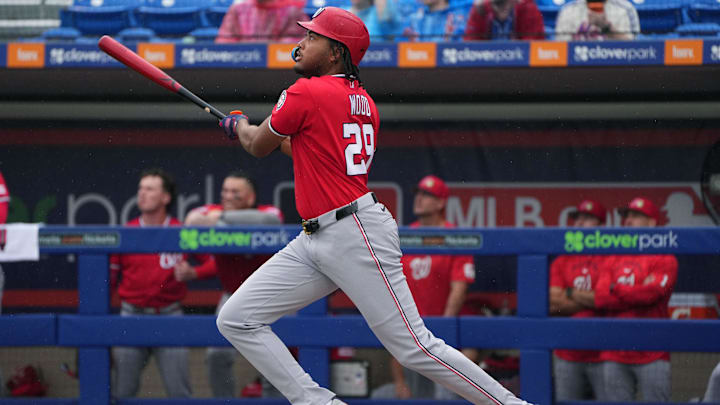
Spring training is underway in West Palm Beach, and the Nationals are off to a 5-3-2 start. March has arrived. Opening Day is this month. So let’s talk about it. What is this team actually capable of in 2026?
The Nationals went 66-96 in 2025. Another winter passed quietly under the Lerners with no splash signing. Contention in 2026 is likely out of the picture. But major changes have taken place inside the organization that offer some hope.
In 2026, I predict the floor at 68-94 and the ceiling at 78-84, with the range of outcomes sitting tightly inside that 10-game window. Yes, that makes me more optimistic than ZiPS, PECOTA and Vegas, which all hover in the mid-60s. But this organization is not the same one that stumbled through the last few years.
Let’s start with the floor, because even in a worst-case scenario, I do not see this team being worse than last year.
This organization simply stands more competent than it was a year ago. President Paul Toboni and GM Ani Kilambi are two young baseball masterminds who cleaned house and moved on from the old-school, innovation-resistant approach that defined the Mike Rizzo and Dave Martinez era. Manager Blake Butera now leads a completely overhauled coaching staff, one that replaced veterans like Darnell Coles and Jim Hickey with younger, analytically minded voices such as Andrew Aydt, Simon Mathews and Matt Borgschulte.
Their goal is straightforward. Turn the Nationals into a player development monster. That means better data, better coaching and an organization built around helping young talent actually reach its ceiling instead of stalling out. You can already see it this spring.
The new regime invested in Trajekt machines almost immediately, something the previous staff infamously refused to do despite players pushing for more advanced tools. Even though the move is unsurprising given the new staff, it is reassuring to actually see a tangible example of the new approach starting to unfold.
Brady House said he “loves it,” and he is off to a red hot start this spring with two home runs and an average flirting near .500. That does not guarantee anything once the games count, but it speaks to a bigger point. The young core has noticed the difference. The Nationals are finally catching up analytically and technologically and no longer lagging five years behind the rest of the league.
The old staff operated one way for a long time. This new leadership is clearly trying something different.
Even in year one of this new staff, I do not see the record being worse than last season because the players are being supported in ways they simply were not before. Better preparation, better information and better development should translate to more competitive baseball over 162 games.
Another reason I predict the floor in 2026 higher than 2025’s 66-96 record is fundamental. This roster is extremely young, and most of it should naturally trend upward.
Seven of the nine projected hitters in the starting lineup are 25 years old or younger. Keibert Ruiz, at 27, is the oldest regular and still in what should be his prime years. James Wood. Dylan Crews. Daylen Lile. CJ Abrams. Jacob Young. Luis Garcia. Brady House. Nasim Nunez. That young core still stands to benefit from another full year of experience and growth. Not all of them will explode onto the scene, but most at least should take incremental steps forward.
Then you look at the pitching. Cade Cavalli could be in for a big season if he stays healthy. Josiah Gray could bounce back after Tommy John. Beyond them, several young or newly added arms in the rotation and bullpen have room to grow or carve out bigger roles. It does not require a Cy Young campaign, just steadier innings than what this team got last year.
Put that together with improved leadership and better preparation, and it is hard to see the record dipping below 66 wins again. If Washington gets above average defense, aggressive and mistake-limiting base running and finds some solid inning-eaters on the mound, it would help. They will also need at least one or two star-level jumps from the young core.
The prospect factor also may come into play. Guys like Harry Ford, Christian Franklin, Abimelec Ortiz and Jarlin Susana could get chances at some point and provide a spark in the nation’s capital. That makes the floor feel higher.
The ceiling, though, presents a different story. I am capping it at 78-84 because the pitching is still going to be rough.
Trading MacKenzie Gore and Jose A. Ferrer takes a hit out of both the rotation and the bullpen, with neither spot replaced at a high level. No proven ace sits at the top. No locked-in closer stands at the back end. The margin for error on the mound is going to be thin.
The overall roster talent, shaky pitching depth and continued unwillingness to start spending heavily limit how far this team can realistically go. In all likelihood, that keeps them from reaching .500 baseball, even if several things break right.
Washington has not topped 71 wins in a season since winning the World Series in 2019. That is the reality of where this franchise has been for half a decade. Washington stands alone as the only team in Major League Baseball not to have signed a free agent to a $20 million contract in more than six years. Until that changes, the ceiling will stay modest.
This is not a team that is going to explode in 2026. It will be another rebuilding and transition year, and the playoffs likely fall out of reach. But that does not mean it merely falls short as another lost season.
In year one of the new leadership, subtle improvement should start to show. The Nationals can become a more disciplined, competitive and respectable squad, even if the record still sits under .500. If that growth comes to fruition, it could finally inspire the Lerners to open the checkbook again. 2026 is a stepping stone for 2027 and beyond.
 Add us as a preferred source on Google