

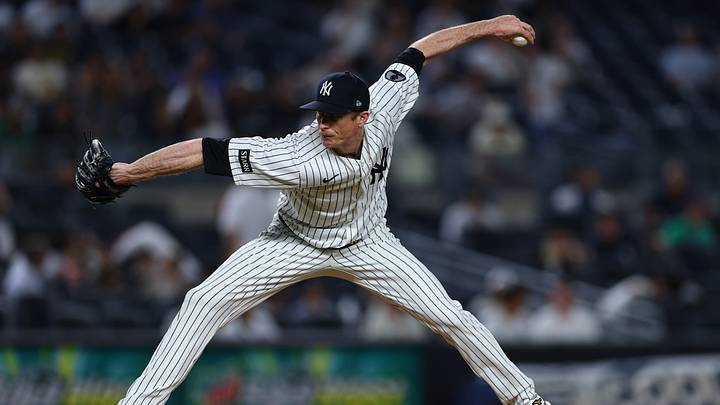
We're starting to get into the weeds now.
Two weeks ago, I ran a piece detailing five potential free agent relief targets the Nationals could pursue this upcoming offseason. Well, surprise, there's more, but we're beginning to dig into the ones that are less obvious. This week I've got two for you that you might not have considered.
Tim Hill
When doing research for this piece, I discovered something pretty eye-opening. Yes, Tim Hill, coming off the worst season of his career at age 36, ran a -1.1 FanGraphs WAR. He also had the lowest K/9 of his career at 3.84. These are not numbers that matter when evaluating the effectiveness of a Tim Hill.
You see, Tim Jim is a submarining lefty, throwing the ball from a -22° arm angle. He throws his sinker over 80% of the time, and he's got a groundball rate above 60% for his career. In fact, his groundball rate in 2026 was the highest it's ever been. Strikeouts are not how Hill makes his living. In fact, in 2024, his K-BB% was even lower than it was this year, and he managed an ERA of 3.36 that year compared to a 4.60 in 2026.
So what was the difference? As it stands right now, one thing appears clear to me: flyball luck. Home run to fly ball ratio, or HR/FB for short, is the sole difference between FIP and xFIP. It's generally regarded as one of the least predictive stats we have, in the sense that within a certain range it's expected to normalize over time. xFIP is identical to FIP with the difference that it's calculated with home run rate set to 10.5% of flyballs induced, which is about league average, as opposed to the actual rate of home runs allowed.
In 2026, Tim Hill's HR/FB was 30.8%. Going back to 2002, the first season HR/FB was tracked by FanGraphs, there's only been one season ever with at least 50 innings pitched with a HR/FB rate higher than that (and in case you're curious, it's 2018 Dan Otero with Cleveland at 31.6%). That's taken from a sample of over 8,000 individual pitching seasons. Otero's numbers in 2018 are eerily similar to Hill's this past year: they both pitched exactly 58.2 innings, with the same HR/9, and both pitchers' xFIPs were about 1.7 runs lower than their actual FIP. That's massively bad luck, and it indicates that there is room for some positive regression for Hill.
A nine-year veteran, Hill will be 37 in 2027. His 21 shutdowns to 12 meltdowns in 2026 aren't awesome, but it's not far off his career norms, and his WHIP was actually the third-lowest of his career last season. xFIP is probably a little misleading in determining his true skill--Hill's career HR/FB, which does normalize per-pitcher over enough innings, is 16.1%, well above the 10.5% mark used by xFIP--but it's unthinkable that it would possibly be quite that bad ever again. He shouldn't be expensive, but if the Nationals shore up their infield defense, Hill's a solid middle-inning option for a team that struggled to find production from lefties in 2026--though Erik Tolman is starting to establish himself.
Brusdar Graterol
Like when I covered A.J. Puk a couple weeks ago, Brusdar Graterol at this stage is more of a concept than anything. Once a well-regarded prospect, ranking as high as 68th on MLB Pipeline's top 100 in 2019 with the Twins, Graterol never quite hit the starter upside he was projected for but morphed into a solid hand as a late-inning flamethrower out of the bullpen, and by 2023 he was devastating hitters with a sinker that averaged 98.6 MPH. He didn't get whiffs, and he didn't need to--he parlayed a 1st percentile swing-and-miss rate into a 99th percentile groundball rate along with pinpoint command en route to 1.4 fWAR in a dominant season.
The injuries never stopped rearing their heads, though. Graterol's hit the major league IL nine times since the Dodgers acquired him ahead of the 2020 season. He missed the first four months of 2024 with shoulder inflammation. When he finally came back, he got into a single game and recorded just one out before suffering a hamstring strain that kept him out for another month. Two weeks after activation, it was more shoulder troubles that kept him sidelined again until the World Series, where he made 3 appearances as the Dodgers pitching staff went all-hands-on-deck to bypass the Yankees.
Graterol finally had labrum surgery that November, and rehabbed all through the first half of 2025. After hoping for an August rehab assignment, that month came and went, and it ended up being that he didn't pitch at all that year. Brandon Gomes told the press he'd be full-go for spring training, but by February of this year Dave Roberts said he was in a "holding pattern." In May, he was finally into rehab games at Triple-A... only to suffer a back injury this time that required season-ending surgery by June.
God only knows what Graterol's status is. In his limited action at Triple-A--just four appearances--Graterol did have decent velocity (averaging 95.5 MPH on the fastball) and continued to induce groundballs at a high rate. He's still just 28, and if the velo is still there, he's worth a flier. Again, after not pitching in the majors for two, nearly three years, he's an unknown quantity, but there's low risk and potentially a lot of upside if he can figure it out, return to form, and stay healthy in 2027.
 Add us as a preferred source on Google