

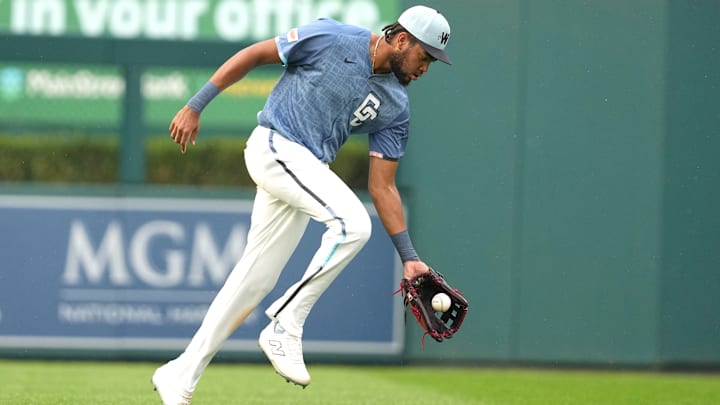
The Washington Nationals have more outfielders than they know what to do with.
It's a good problem to have, especially when you consider that this is the same team that started Eddie Rosario in center field on Opening Day 2024, but it's still a problem the team needs to find a solution for sooner or later. For all intents and purposes, let's assume that there's room for four dedicated outfielders on the Major League roster, plus a DH that could be used as a rotating slot. Let's also assume that the Nationals aren't suddenly going to decide to spend the money to lock up Kyle Tucker or Cody Bellinger, and we can go from there.
The shoe-ins
What makes this roster chase so compelling is the limited number of spots, because two of those spots are basically already taken. James Wood and Dylan Crews each had their struggles in 2025, but unless they get hurt, there's no realistic reason either should miss the Opening Day roster. What does matter, though, is where they slot into the positional chart.
Crews came up as a center fielder. At the collegiate level, he only spent his freshman year in right field before moving to center full time as a sophomore and junior. He continued playing center in the weeks following his professional debut, but the team decided to acclimate him to right field with Jacob Young looking, at least at the time, like the primary option in center. Dylan's stayed mostly in right field since then, moving over to center on Young's off days.
As we'll touch on later, those off days figure to start becoming a little more frequent in 2026. With more innings to be had in center field, it's unclear how the Toboni-Butera regime will tackle Crews' case. He still ran an 89th percentile sprint speed in 2025, which would play up at a rangier position. Either way, he's a lock to start the year in the MLB lineup.
Wood's a little simpler of a case to tackle. He might've come up a center fielder, but the Nats seem intent to leave him in left field. Defensive metrics were split on him, with Statcast reporting him as dreadful while Fielding Bible (DRS) was a little more lenient. Wood got some chances to DH when the team cut Nathaniel Lowe and Josh Bell slotted into the bulk of the first base reps the remainder of the season; it's possible, maybe even likely, that he'll start seeing more of that going forward.
The new analytically-minded front office, though, surely understands the development and performance penalties that apply to a primary designated hitter, and they'll almost certainly try to get him routine reps in the field where they can.
The frontrunners
That leaves one starting role, a fourth outfielder bench slot, and potentially a third corner opportunity on days Wood takes the DH slot (or an opportunity in the DH slot itself).
One might imagine that the primary frontrunner for the third of three starting roles is Daylen Lile, the upstart who commanded a fifth-place finish in National League Rookie of the Year voting for 2025. Among hitters who qualified for select Statcast metrics, Lile was in the 100th percentile in both expected batting average and launch angle sweet spot, meaning that there might be some serious validity to his extra-base pop. 2026 ZiPS projections aren't out yet for Nationals players, but Steamer (another projection model) has Lile posting a 109 wRC+ in 458 plate appearances, good for 2 WAR which is the threshold for an average major league starter.
That being said, he struggled in the field: -14 DRS and -10 OAA across just over 600 innings is brutal, to the point where Lile's weighted defensive runs value per FanGraphs nearly offset his contributions with the bat. If Daylen can turn it around and parlay that 29.1 MPH sprint speed into results in the outfield, starting him in a corner will become significantly easier; otherwise, he might be splitting time with Wood at the DH spot.
That leaves Jacob Young to slot into the fourth outfielder spot. For the second year in a row, Young was one of the most valuable defensive outfielders in baseball in 2025. His offensive production, however, cratered, leaving him with a .583 OPS and the fifth-worst wRC+ (66) among over 240 MLB hitters with at least 350 plate appearances. Jacob went right to work this offseason: Driveline Baseball posted a YouTube video last month showing him training at their Florida campus.
He's no stranger to putting in work; this tweet from February illustrates how much muscle he put on last offseason, but that didn't help his slugging percentage as it tanked by over 40 points. Young's probably on his last chance to earn a starting opportunity with the Nationals, but if he displays progress, he just might earn that opportunity and parlay it into a 3-win season.
The fringe candidates
And here's where things get really interesting. Let's start with Robert Hassell III. Bobby Barrels rebounded from an injury riddled 2023-24 to decimate the Arizona Fall League in 2024 before slashing .310/.383/.456 in 76 total games at Triple-A Rochester in 2025. That didn't translate in the Majors, though: he plummeted to a 58 wRC+ in a little over 200 plate appearances. The walks cratered, the strikeouts shot up sky high.
He'll still only be 24 on Opening Day, so there's time for him to figure it out, but unless it's a purely mechanical issue, it's going to be tough for Hassell to find time to improve against Major League pitching with limited MLB plate appearances and the ever-growing gulf between MLB and Triple-A pitching talent.
There's also Christian Franklin, the former Cub who the Nationals recently added to the 40-man roster to protect him from being selected in the Rule 5 Draft. I wrote at length about Franklin a few weeks ago, and I stand by the sentiment: Franklin might not be in high contention for the Opening Day roster, but there's not a lot left for him to prove in the minors. His versatility in the outfield will also go a long way towards helping him potentially find a spot on the MLB roster.
2023 10th-rounder Phillip Glasser is a name to watch, too. The Nationals named him their Minor League Hitter of the Year in September as he continued to rocket up the organization. Glasser, who turned 26 on Wednesday (happy birthday!), isn't ranked in the organization's top 30 prospects by either FanGraphs or MLB Pipeline, but with some seasoning (he's only played 12 games at Triple-A) Glasser might be a mid-season call-up.
Also worth considering in a fringe role is the team's 30th-ranked prospect in Andrew Pinckney. While he doesn't quite boast the standout raw hitting numbers Glasser does, Pinckney's coming off a 20-homer season at Rochester. The strikeout rates are still high, though; a 29% K rate in the minors doesn't usually favorably translate into success at the big league level.
All of this is to say nothing of the several potential short-term free agent adds the team could make in free agency; even the addition of a Tommy Pham or JJ Bleday could pay dividends should the team play their cards right. Who do you want the team to sign, and who should be on the Opening Day roster? Sound off with your thoughts in the Twitter replies @DistrictOnDeck.
 Add us as a preferred source on Google