

The tale of two cities continues into the middle of April for the Washington Nationals.
Following play on Monday, the Nats now rank 4th in the majors in wRC+. Their strikeout rate is 5th-best in Major League Baseball, and they're one of five teams with a slugging clip above .400. Over the last week, that's largely been on the back of right fielder James Wood.
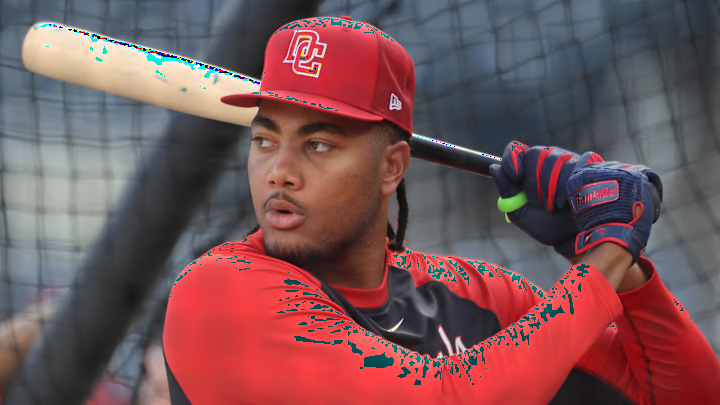
Over six games against the Cardinals and Brewers, Wood picked up six extra base hits (3 home runs) with 8 runs scored and batted in while swiping two bases. His 12 weighted runs created in that span were far and away the most of anyone in MLB. James rode that success to his first career selection as National League Player of the Week on Monday.
It's a heartening sign for the big slugger after a 9-game span to open the year where he struck out in 38% of his plate appearances and posted a wOBA of just .259. Wood now joins teammate CJ Abrams in the top 20 in MLB qualified hitters in wRC+. He's the first National to be awarded this honor since May of 2024. One of his two stolen bases for the week was a successful double steal that saw him swipe home plate.
Looking under the hood reveals even more eye-popping statistics. Statcast reveals that Wood's EV50, the average exit velocity of the hardest 50% of his batted balls, is second in baseball (108.2 MPH) behind the typical suspect in Oneil Cruz. He leads the majors in balls hit at or above 115 MPH. And he's doing all this despite regressing thus far in terms of pulled fly balls. If Wood starts getting ahead of pitches, he might actually send a ball to the moon--or he might just keep swatting 400-foot tanks to the opposite field.
Things aren't so rosy on the other side of the ball. Those same Nationals are now dead last in pitching FanGraphs WAR, and it's not close. At -2.2 fWAR, they trail the second-worst Astros by over a win and a half. They're averaging two home runs allowed per game while still managing to remain in the bottom four in both walks and strikeouts per nine innings.
We're approaching a level of ineptitude that we've never seen from Nationals pitching. Last year's 5.35 team ERA was the worst in franchise history, and the 2026 Nats are currently well north of6. There's a few upsides, but they're not thrilling. Cade Cavalli and Jake Irvin look this year like they're capable of being Major League pitchers, but Cavalli especially has been unable to command his pitches. Foster Griffin had tough underlying numbers but still weathered three starts against three National League powerhouses to a sub-2 ERA. Left-hander Cionel Pérez has settled in recently after a disastrous lead-blowing outing against the Dodgers where he acknowledged that he was tipping his pitches.
Beyond that, the pitching staff has been nigh-unwatchable. Ken Waldichuk, once a strongly-ranked prospect with the Yankees, immediately knew something was wrong when he left the field on Sunday and has now been recommended for his second Tommy John surgery in three years. Five pitchers on the active roster have an ERA of 5 or worse, and Miles Mikolas is still getting playing time.
It's a waiting game for the Nationals, ultimately. The system's pitching depth is already being tested. This wasn't an entirely unexpected outcome; the team knew they didn't yet have the internal resources built up to compete this year, and the offense's early success was not guaranteed. As the season trudges on, and teams begin the slow roster churn, the Nationals, much the same way they did in the offseason, will play the waiver wire game, trying to find innings anywhere they can. The hope, ultimately, is that at least one or two of the arms they acquire off the wire will become a competent Major League mainstay.
It's generally accepted that, on the whole, we understand hitting more than we do pitching. What I mean by that is that MLB front offices are better equipped to identify what potential a hitter is capable of unlocking than they are to speculate on what a pitcher is capable of becoming. We can observe pitch grips, mechanics, movement, and velocity, but simply observing what someone is doing now often isn't enough to get them to where they're able to go.
So it's a daunting task ahead of the Nationals. They're not going to suddenly turn around and become a league-average pitching staff over the remaining 140-plus games. But as much as a fan watching every game might be frustrated or even outraged over the routine 30-minute inning that sees three or four or more Nationals take the mound before the team can record three outs, reinforcements will be coming. They might not be very good either. But good teams find production somewhere; the internal minor league development might not show us returns for a couple years, and the waiver wire is still going to take another couple of weeks to really heat up. All we can do is sit and wait.
 Add us as a preferred source on Google