

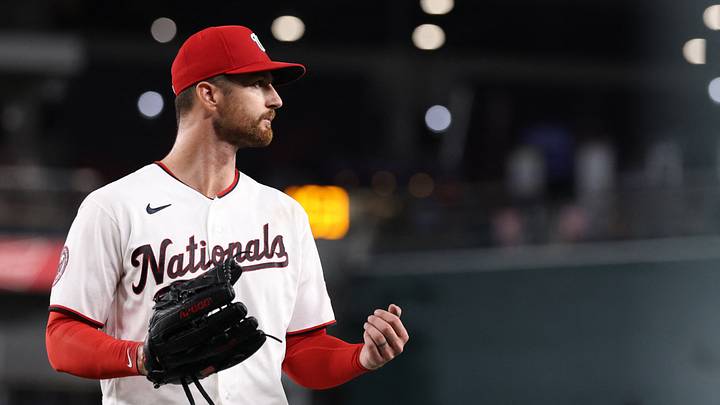
In a recent discussion post, Nationals beat writer Spencer Nusbaum mentioned the presence of scouts from both the Tampa Bay Rays and the Philadelphia Phillies at Nationals pitcher Foster Griffin's most recent start. Bennett covered that story on Monday. After the Nats got trade season started on Sunday by acquiring Connelly Early from the Boston Red Sox for Curtis Mead, and with the trade deadline approaching this upcoming Monday, Griffin is going to be a hotly coveted piece on the market.
Foster's a true rental, meaning he will enter free agency at the end of the season, which means that the return will be ultimately a little limited, but starting pitching always comes at a cost for contenders, and Griffin was an All-Star this season running a 2.76 ERA as of Monday evening. It's unclear how the market will treat his underlying numbers; a relatively pedestrian strikeout rate means his under-the-hood numbers (3.69 xFIP, .249 BABIP) are a little tenuous, but neither Philadelphia nor Tampa Bay are looking for a top-end guy but rather someone who can simply start a Postseason game and give quality innings down the stretch.
Philadelphia Phillies
Look, trading our best starter to the Phillies of all teams wouldn't exactly feel good. It's about the future, though. The Phillies in this scenario get Griffin for two months, before the Nationals intend to make an all-out push for the Postseason, and the Nats get future assets in return. Philly has three top starters in Cristopher Sánchez, Zack Wheeler, and Jesús Luzardo, but a Postseason run generally requires a fourth man available, and neither Aaron Nola nor Andrew Painter have been particularly reliable this year.
It doesn't feel insane to think that the Nationals might be able to pry away Gage Wood, one of the Phillies' top prospects, if they gave up Foster. Wood's their top-ranked prospect according to MLB Pipeline (no. 48 overall), and FanGraphs has him 45th overall, though ranked behind fellow top prospect Aidan Miller. Baseball America was a little more bearish on him, as he only debuted on their top 100 in June.
Wood was the Phillies' first-round selection in last year's draft, and he's striking out 36.2% of the batters he's faced in the mid-minors in his first full professional season. The primary concern is the depth of his arsenal; his fastball and curveball are his two main pitches, but as he's toyed with a slider and a hybrid changeup-splitter, nothing has yet stood out as a tertiary weapon. If anything, that might be the flaw that allows the Nationals to land him; he's not a can't-miss guy, and a true rental like Griffin was never going to land one of those, but a high-upside, high-variance pitching prospect is something the Nationals can work with right now.
Tampa Bay Rays
The sentiment of "don't trade with the Rays" has been disproved over the past couple of years, but this is still a little bit of a tough sell. The Rays have a relatively deep rotation with Drew Rasmussen and Shane McClanahan at the top, low-K hero Nick Martinez, and relievers-turned-starters Griffin Jax and Ian Seymour bringing up the rear. Free agent signing Steven Matz was also just activated off the IL but figures to take long relief duty for the time being.
The Rays don't quite have the level of pitching prospect the Phillies do, but there's a couple of options on the lower end of the top 100. Brody Hopkins ranks highest among arms in the Tampa Bay system, but his command is extremely shaky. The 24-year-old righty acquired from Seattle in the Randy Arozarena trade has walked over 20% of the batters he's faced this year at Triple-A in over 80 innings, and his time on the top 100 might not be long for this world if he can't get that under control.
Perhaps more appealing to the Nationals is Michael Forret. Two years younger than Hopkins, he's also at Triple-A Durham after being acquired in the offseason from Baltimore in the Shane Baz trade. Forret's logged 87 innings in 18 starts this year across Double- and Triple-A, managing above-average 3.31 ERAs and 4.34 xFIPs. Perhaps of even more interest to baseball fans, this trade would continue the infamous Delmon Young Trade Tree.
Tampa Bay have the resources to make the swap, but they've also got acceptable SP depth right now. Ultimately, this comes down to what they're willing to give up for Griffin.
Just hold him?
The case might be that the Nationals could simply hold onto Foster. The rationale is twofold: it allows the Nats to keep their best starter in the event that they do make a push for the Postseason, and, all things considered, it likely doesn't mortgage their future too much, if at all--the team can tender Griffin the qualifying offer in the offseason. If he accepts, he returns to the Nationals for 2027; if he declines and ends up signing with a different team in free agency, the Nats receive an extra draft pick from the signing team.
It might turn out that that draft pick ends up being just as if not more valuable than a trade return, but caution is advised here--it's often better to pursue the devil you know over the devil you don't. Teams will be offering established minor leaguers that are much closer to the big leagues in trade talks than whoever the Nats would be taking in a hypothetical 30th to 50th pick in the 2027 draft.
It's going to be an interesting trade deadline for the Nats, to say the least. Griffin is one of several pieces that could be on the move depending on how the team chooses to approach the rest of the season. As of a week ago, the team was reportedly still undecided as to what his future was with the team. Baseball ops president Paul Toboni has made it clear that between competing now and in the future, his focus is on the latter, but if the opportunity arises, he'd also like to get as deep as possible in 2026. We'll see how that shapes up in the coming week.
 Add us as a preferred source on Google