

The calendar has flipped to 2026. Free agency is still ongoing. Opening Day is 79 days away. The Nationals have been quiet so far this winter. But January is still young, and history shows that meaningful moves do not always occur early in the offseason.
Some of the most important free agent signings in Nationals history came after the New Year. Those deals filled important needs and played a major role in some of the best seasons the Nationals have had.
With another January underway, here is a look back at the three most important January free agent signings in Nationals history.
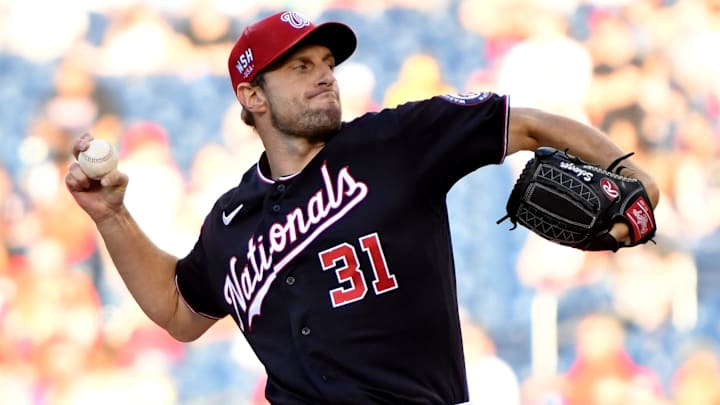
1. Max Scherzer (January 2015)
The best free agent signing in Nationals history happened on January 21, 2015.
On that day, Washington officially announced the signing of Max Scherzer to a seven-year, $210 million contract. At the time, it marked the largest deal ever given to a right-handed pitcher and a clear signal that the Nationals were serious about winning.
Scherzer arrived in Washington from the Detroit Tigers. Already an established ace, he still exceeded expectations. From 2015 to 2021, he posted a 2.80 ERA across 189 appearances and struck out 1,610 batters. He won two National League Cy Young Awards in 2016 and 2017 and was named an All-Star five times in six full seasons.
His résumé in D.C. speaks for itself. He threw two no-hitters in 2015, recorded a 20-strikeout game in 2016 and posted a 300-strikeout season in 2018. He finished every full season in Washington with an ERA under 3.00, with the exception of the shortened 2020 campaign.
More than anything, Scherzer gave the Nationals exactly what they paid for. He was reliable, durable and dominant. Every fifth day, Washington felt like it had the edge.
That impact reached its peak in 2019. Scherzer formed a key part of the rotation that carried the Nationals through the postseason and helped deliver the first World Series title in franchise history. He started Game 7 in Houston and pitched through five innings in the championship clincher.
Scherzer’s time with the Nationals ended in July 2021 when he and Trea Turner were traded to the Los Angeles Dodgers for a prospect package headlined by Josiah Gray and Keibert Ruiz. Scherzer departed having given the Nationals all they could have hoped for. He delivered elite production for nearly the entirety of his contract and played a central role in the most successful stretch in franchise history.
2. Daniel Murphy (January 2016)
Daniel Murphy was not a flashy signing on January 6, 2016, which is part of what makes it so memorable in retrospect.
The Nationals signed Murphy to a three-year, $37.5 million deal after missing out on other second base options. He was coming off a huge postseason run with the Mets, but questions swirled about whether he could sustain that kind of performance. To many, Murphy still looked like a solid, reliable hitter rather than a true middle-of-the-order star.
That perception changed quickly.
Murphy put together one of the best offensive seasons in Nationals history in 2016. He hit .347 with 25 home runs, 47 doubles and a .985 OPS. He led the National League in doubles, slugging percentage and OPS. He finished second in MVP voting and won the Silver Slugger at second base.
He followed that season with another strong year in 2017, hitting .322 with 23 home runs while earning an All-Star selection and a second straight Silver Slugger. Over his two full seasons in Washington, Daniel Murphy established himself as one of the most productive hitters in baseball and helped the Nationals win the NL East in both 2016 and 2017.
In 342 games with the Nationals, Murphy hit .329 with 54 home runs, 226 RBIs and a .930 OPS. His production often peaked against the Mets, Washington’s division rival and Murphy’s former team.
Murphy’s run in Washington ended in August 2018. The Nationals, faced with mounting injuries and a season slipping away, traded Murphy to the Cubs for Andruw Monasterio and cash. This concluded what began as a relatively modest January signing that turned into one of the most efficient free agent deals in franchise history.
3. Adam LaRoche (January 2011)
Adam LaRoche arrived in Washington with little fanfare, but at the time, stability mattered.
He was a proven veteran with steady power and solid defense, even if he was never a headline name. After LaRoche spent the 2010 season with the Arizona Diamondbacks, the Nationals signed him on January 7, 2011, to a two-year, $16 million deal as the replacement for Adam Dunn at first base.
LaRoche’s first season did not go as planned. He tore his labrum and played just 43 games in 2011, finishing with career-low offensive numbers. The Nationals stuck with him through the injury, and that patience paid off.
He delivered the best season of his career in 2012. LaRoche hit 33 home runs, drove in 100 runs and helped lead Washington to its first NL East title. He won both the Gold Glove and Silver Slugger at first base and finished sixth in MVP voting.
LaRoche re-signed with Washington on January 8, 2013, agreeing to a two-year deal to remain at first base through the 2014 season. After a down year in 2013, he bounced back in 2014, hitting 26 home runs and driving in 92 runs while helping Washington win another division title.
Over his time with Washington, LaRoche totaled 430 hits, 82 home runs, 269 RBIs and a .781 OPS across 489 games.
Following the 2014 season, Washington chose to move Ryan Zimmerman to first base and let LaRoche walk in free agency. His exit was expected, and LaRoche later signed a two-year deal with the Chicago White Sox before retiring in 2016 following a dispute over his son’s clubhouse presence. LaRoche’s January 2011 signing with the Nats served its purpose, as he helped lay the foundation to move the Nationals out of the rebuild and into relevance.
 Add us as a preferred source on Google