

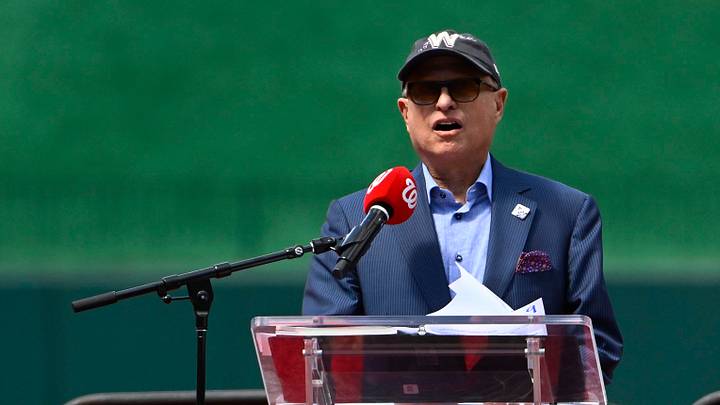
It's become clear to many fans after a successful (at least until August) season for the Nationals that there is one main bottleneck that is keeping this young team from taking the next step and reaching the postseason.
Spending.
For years, during the 2010s the Nationals were a consistent top-10 spender in baseball, and in that same era, never finished lower than 2nd in the National League East. Ted Lerner was spending, the Nationals were winning, and baseball in D.C. was fun and full of optimism year in and year out.
The magical world series run of 2019 came and went, and the Nationals still remained spenders into through the 2021 season where they fell out of the top-10 in spending, and by the 2023 season they had fallen to 22nd, and have remained in the bottom-third of spending since.
Why?
I think one of the biggest reasons that the Lerners, specifically Mark who took over for Ted in 2018, has paying almost $70 milllion annually to two players -- Stephen Strasburg and Patrick Corbin.
Strasburg, as we all know, put his body and career on the line to help Washington win the World Series title in 2019. He was rewarded handsomely for his effort, receiving the World Series MVP award, and also a new 7-year, $285 million contract too. What the Nationals didn't (and couldn't) know at the time that Strasburg would only pitch roughly 30 innings over the life span of that contract, before retiring. The Nationals paid out the entirety of his contract, fully guaranteed at signing.
Patrick Corbin on the other hand, signed a 6-year, $140 million contract before the 2019 season, and was a huge part of Washington's championship run, yet over the last four years of that contract, he was totaled -4.0 WAR while being paid roughly $22.5 million a year. This quickly tanked his popularity -- Nationals fans were looking forward to the day he (and his cap hit) were out of D.C..
The blunt truth is this -- the Nationals have not spent enough to be a competitive club in recent years. After missing out on signing Juan Soto to a contract extension, and subsequently trading him for a haul of prospects which included current franchise cornerstones James Wood and CJ Abrams, the Nationals seemed to commit to a rebuild, and with that, a low payroll. On purpose.
The lack of spending in recent years have been frustrating -- we all know that. With that in mind, perhaps this is the year that things change, and the Nationals shell out major cash to improve their team in the offseason: Until the trade deadline, the Nationals were contenders for a wild card spot and playoff appearance. That is, until they punted the season in the name of players under longer team control or young prospects.
We have now seen that the cornerstones of this franchise: Cade Cavalli, James Wood, CJ Abrams, and their supporting cast of youngsters can, in fact, get this team close to the playoffs. They just need some help from establish veterans and contributors around the edges. While I won't spend time here detailing who that help might be (we'll be talking about that plenty as we await free agency and the lockout), let's take a look to see what the Nationals have to work with financially.
Overview
For those who are unaware, baseball is currently the only major (Big-4) league in the USA that does not operate with a salary cap; the NHL, NFL, and NBA all have limits on how much teams can spend. While the MLB does have a competitive balance tax to try and keep teams from spending obscene amounts of cash. As seen with the Los Angeles Dodgers and New York Mets, among others, that hasn't quite worked as anticipated.
(Note: The implementation of a salary cap is the main talk point of negotiations of a new collective bargaining agreement, which could likely lead to a work stoppage and lockout this offseason.)
For purposes of dialogue and this article, we can act on the assumption that regardless of the outcome of CBA negotiations bringing a salary cap or not, the Nationals should (or may have to) increase their payroll. This article provides a look at current financial commitments, and space for additional spending.
According to Spotrac, the Washington Nationals are projected again in the bottom-third of spending, 22nd to be precise. Next year, the Nationals only have one player officially on the books for over $10 million, that being Cade Cavalli fresh off signing his four-year extension. CJ Abrams is projected to join him, as he heads to arbitration again, projects for his 2027 salary also surpass that $10 million figure, but he also looms as a potential extension candidate.
Keibert Ruiz is on the books for about $6 million next year. That's pretty much it. The Nationals are so young (and cheap) that they do not hold any other signficant payroll commitments. Even key contributors like James Wood and Daylen Lile are still in their pre-arbitration years, meaning they make very little money. For what it's worth, this is Wood's final year of pre-arbitration, meaning his salary will jump signficantly after this season.
Spotrac projects that the Nationals are $143 million dollars under the competitive balance tax -- that's $30 million more than their entire projected cash payroll of $113 million. In other terms...
The Nationals are currently projected to spend less than half of what they are allowed to spend, without tax penalty.
No longer are the Nats on the hook for paying Stephen Strasburg $35 million a year to not play (not Strasburg slander allowed here) or Patrick Corbin $20 million or more for a 5+ ERA. This team has space, and only needs a commitment from ownership to spend money. No other financial, contractual, or roster building constraints stand in their way.
This young team is ready to take the next step and make an appearance in the playoffs in October -- but they need some help to get there.
Mark Lerner must leave the roster construction up to his new brain trust of Paul Toboni and Blake Butera, and simply spend the cash. Nothing stands in his way -- and if he wants to be the owner of a winning franchise? The choice is clear.
Will the Nationals spend this offseason? Who will they sign? Let me know in the comments or on X, (@andrewpindc)
 Add us as a preferred source on Google