

The Baseball Writers' Association of America Hall of Fame ballot for 2027 was announced Monday morning through MLB channels and the National Baseball Hall of Fame website.
14 first-timers and 13 returnees are on the BBWAA ballot for the Hall of Fame Class of 2027!
— MLB (@MLB) November 16, 2026
Who do you think will make it to Cooperstown? pic.twitter.com/LICRGrKpDW
The case for Zim
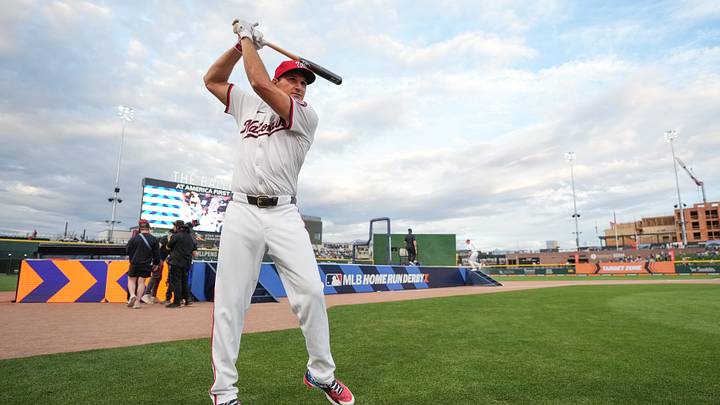
Debuting on the ballot is one of the most impactful players in the history of the Washington Nationals, so much so that he commanded the nickname of Mr. National. Ryan Zimmerman was the team's first-ever draft pick after moving to Washington in 2005, debuting that very season at age 20. Over the next 17 years, Zimmerman spent every season of his career wearing first the interlocked DC and later the Curly W, amassing over 1,800 hits with the team in one shy of 1,800 games and nearly reaching 300 home runs.
It's going to be tough for Zimmerman to break into Cooperstown, but to not so much as present an argument would be to admit defeat. Through 2010, Zim was among the best baseball had to offer in terms of third basemen. Over the five-year period from 2006 to 2010, only three third basemen were more valuable by fWAR: Álex Rodríguez, David Wright, and Miguel Cabrera. Both A-Rod and Wright remain on the ballot from last year, and Cabrera will almost certainly enter the Hall on his first attempt.
Zim didn't have the raw offensive output those other three did, although back-to-back seasons with 6.6 fWAR and a 130 wRC+ or better, including 33 home runs in 2009, proved that he was capable of it. Rather, he made his living at the hot corner, ranking 4th among all third basemen in Defensive Runs Saved from '06 to '10. Two of the men above him, Adrián Beltré and Scott Rolen, are already in the Hall of Fame, and the third, Brandon Inge, was only a major leaguer because of it. Zimmerman developed a reputation as one of the premier defensive infielders in the league.
That dropped off pretty steeply in 2011. An abdominal muscle tear during Spring Training, worsened in the first weeks of the season, cost Ryan 60 games that campaign. His production, both at the plate and in the field, declined in turn. Instead of being a 130 or 140 wRC+ guy, Zim settled into a consistent 120 or so. Still very good and reliable offensively, the attention of the media turned to his defense, which fell from +22 DRS at its peak to alternating -1 and -5 between years.
It would come out after the 2012 season that his midsection was not the only thing bothering him. Repeated motions had caused bone spurs and damage to the muscles in his throwing shoulder, which despite him not reporting pain in the moment, he recognized after the fact had changed his mechanics for the worse and caused his reliability to slip. Zimmerman eventually moved off the position and, after a brief stint in left field in 2014, moved to first base full-time.
Ryan was far from done. He surged in 2017, helping power the Nationals to 97 wins with a career-best 36 home runs and .573 slugging clip. While that was his last truly great year, Zim remained the lifeblood of the team. Two separate IL stints for plantar fasciitis in 2019 limited him to 52 regular-season games, but his presence was felt during the Postseason. A three-run bomb in Game 4 of the NLDS was critical in the Nationals rallying to overcome a 2-1 series deficit against the reigning NL champion Dodgers.
He wasn't done. He came back in Game 1 of the NLCS against the Cardinals to rob Tommy Edman of a screaming line drive knock to open the 8th inning and keep an Aníbal Sánchez no-hitter alive, then went bang, zoom off Gerrit Cole in the 2nd inning of Game 1 of the World Series as the Nats came from behind to eke out a 5-4 series-opening victory. That miracle team would go on to win the World Series with all hands on deck, including the efforts of no. 11.
When all was said and done after the 2021 season, Zimmerman finished with 40 bWAR, two All-Star appearances, back-to-back Silver Slugger wins, a Gold Glove, and a World Series ring to polish it off. Among third basemen, he ranks 42nd in terms of JAWS, a metric commonly used by those projecting the candidacy of a ballot member. Several third basemen behind him are in the Hall, but all of them retired long before you, I, or Zim were born. Most importantly, he ranks 1st out of 2 on the JAWS leaderboard among third basemen with the last name Zimmerman: Heinie Zimmerman, who played from 1907 to 1919, is 65th.
One thing Ryan has going for him is the commitment to a singular team. Hall of Fame voters have historically loved one-team guys; it enhances the narrative around a name, and getting a chip late in his career pushes that further. Even with the pedigree he has, Yadier Molina's incoming candidacy would be negatively impacted in a perceptible way if he wasn't a Cardinal his entire career. For Zimmerman to wear the Curly W until his retirement represents the willingness to be the face of a franchise that needed him most. Even if he doesn't make the Hall of Fame, the team has already retired his number and he will, forever, be Mr. National.
Other Nationals on the ballot
Zim's not the only former National to debut the ballot. There are three others, though two have got at best an outside chance of surviving their first year on it.
The first is Asdrúbal Cabrera, who played over 1,800 games from 2007 to 2021. Cabrera's time with the Nationals was short but impactful over two stints. The team first acquired him at the 2014 trade deadline from Cleveland, sending over 14th-ranked prospect shortstop Zach Walters. Cabrera was solid in that time, primarily playing second base as an upgrade over Danny Espinosa, who was having a miserable season. He recorded 1.0 fWAR with a 95 wRC+.
The Nationals reunited with Asdrúbal in their 2019 championship season. Cabrera had signed with Texas to serve as their starting third baseman, but despite standout seasons from Lance Lynn and Mike Minor at the top of their rotation, it was a lost season for Rangers. The team cut Cabrera, who had a 79 wRC+ through 93 games, shortly after the deadline, and the Nats picked him up three days later.
That prompted a brief Linsanity run for Cabrera, who ran a .404 on-base percentage in 146 plate appearances as the Nats went 36-18 to make a Herculean push into the Wild Card. The Postseason was less kind to him as he slashed just .233/.250/.267, but he made his mark in Game 2 of the World Series with 3 RBI. He played the full 2020 season with Washington primarily at first and third base after Anthony Rendon's free agency departure and Ryan Zimmerman opting out, but was unable to recapture the charge his bat found in August of the previous year.
Also on the ballot is Jon Lester, brief as his time with Washington was. The team signed the five-time All-Star and three-time World Series winner to a one-year deal in 2021 hoping his best years were not fully yet behind him as they looked to make the Postseason with the unit of Soto, Scherzer, and Turner still intact. That did not happen, as the team crumbled in July following a 19-9 June surge and the selloff began. Lester, whose ERA was north of 5, somehow earned a trade to St. Louis, a team in desperate need of pitching upgrades. Lester did them no favors, but the Nationals came out easy victors by landing Lane Thomas in the swap. Lester finishes with 43.4 bWAR, but if he earns election to the Hall, his plaque will certainly not feature a Washington Nationals ballcap.
The last of the three is Starlin Castro. Castro, who debuted in 2010 at age 20 with the Cubs, was a young standout in his tenure on the North Side. He settled into a relatively league-average role-player position, moving primarily to second base after being traded to the Yankees before the 2016 season. Notably, Castro was one of the returns in the awful Giancarlo Stanton trade between New York and Miami.
Castro signed with Washington for the 2020 season, but only made it into 16 out of the 60 games that season after fracturing his right wrist making a diving play in mid-August. Castro hitting the injured list allowed Luis García Jr. to make his debut with the big league team. Entering the second year of a two-year contract in 2021, Castro shifted to a starting third base role with the team. It wasn't a terrible season on the field, as the 31-year-old hit to a 91 wRC+ despite an uncharacteristic lack of pop at the plate, and he played solid enough defense at the hot corner.
Things turned sour in July, though, when Castro was suspended 30 games at the end of the month by the league for violating its Joint Domestic Violence, Sexual Assault and Child Abuse Policy. The team immediately distanced itself from Castro, and he was released upon completion of the suspension. On the field, Castro had a solid career, but while he was never formally charged--and this is not to say that I believe that the lack of criminal charges implies a lack of guilt--the suspension effectively ended his time in the major leagues. He was playing in LIDOM as recently as last season. Castro's almost certain to fall off the ballot in his first year on it.
 Add us as a preferred source on Google