

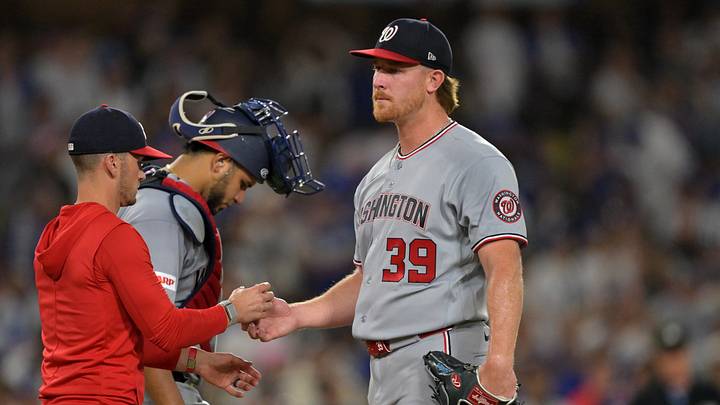
On Tuesday, the Washington Nationals blew their 38th save of the year as a team, at least according to MLB's record-keeping. It's a dubious distinction for Washington, who entered the All-Star break a game under .500, who had a winning record after April for the first time since 2021, and who were relevant in the wild card race at least until August.
Perhaps, however, it's worth taking a more positive slant on. The Nationals were never supposed to be in this position to begin with.
The flip side to the Nationals setting the all-time blown saves record
Including followers--a strategy the 2026 Nationals embraced for certain pitchers like Zack Littell and Miles Mikolas, who weren't particularly effective but the Nationals needed length out of--Nationals relievers have been relied upon to get, on average, more than four outs per appearance this year. That's a large, sudden uptick from 2025, when Davey Martinez and interim manager Miguel Cairo averaged almost exactly three outs per appearance. The bullpen's already thrown 50 more innings than it did last year in 127 fewer combined appearances.
That signals a shift in managerial philosophy from first-year manager Blake Butera, who, at times, has shown inconsistencies in knowing which buttons to press and when that are characteristic of a skipper in his first campaign at the helm. Despite this, the bullpen's running an ERA more than half a run better than it did last year. Granted, that number still starts with a 5, so it's not exactly sunshine and rainbows, but it's an unexpected improvement.
Another context- and leverage-based metric is shutdowns, and its inverse, meltdowns. Coined by Tom Tango and introduced by FanGraphs in 2010, shutdowns and meltdowns are a win probability-based way to evaluate the game-to-game performance of relief pitchers. If the pitcher's performance results in his team's likelihood of winning the game increasing by at least 6%, he earns a shutdown. If it falls by 6% or greater, he's assessed a meltdown.
The 2026 Nationals have 104 meltdowns entering play on Tuesday. That's tied for 20th all-time in a single season, and it's the most they've had since 2021, when they finished June 40-38 only to completely implode and go 25-59 in the second half of the year. Consider other team seasons with this total, though. The 2024 White Sox (41-121), who the Nationals are almost a lock to surpass in the coming weeks if not days, finished with 119 SD and 122 MD. The 2006 Royals (62-100) and 2009 Nationals (59-103) also had one more meltdown than shutdowns. The 2026 Nationals are firmly above water in that regard at 128-104.
So why does it feel so much worse than it did last year? There are still performance-based issues. Nationals relievers are running the worst K-BB% as a unit the team has seen since before the 2010s, striking out batters less than 20% of the time for the first time since 2009. But saves, and conversely, blown saves, are situational. A bad bullpen doesn't generate a huge blown save total on its own, and looking at the save opportunities chart, that becomes evident: the 2025 Nationals had 57 save opportunities all year. Those save opportunities are a function of the offense.
From 2025 to 2026, the Nationals offense jumped fourteen points in wRC+, from 91 (9% worse than league average at the plate) to 105 (5% better than league average). FanGraphs also scores them nearly 13 runs better on the basepaths this year than they were in 2025. That's resulted in the team going from 4.24 runs per game to 5.14. It's the second-best mark in the majors this year, only behind the Cubs. To blow leads, you have to have leads, and it's incredibly painful to have chances to win ripped away from you time and again, especially when you're used to the dull pain of losing 90 to 100 games every single year.
How do the Nationals make sure this doesn't happen again in 2027, assuming there's baseball to be had? It's hard to say. Relievers are inconsistent year-to-year. They'll lose a tick on their fastball or a couple inches of run on their sweeper and all of a sudden their two-pitch approach will go from devastating to borderline unplayable. Ryan Walker broke out and usurped Camilo Doval as Giants closer in 2024, posting a 40-10 SD-MD mark. Two years later, he's got a 7.16 ERA, his strikeouts have crumbled, his walks have ballooned, and he's been optioned three times in 2026. Sometimes a reliever's effectiveness will disappear and return just as quickly. Tanner Scott signed a four-year deal with the Dodgers in 2025 after two elite campaigns, then posted negative fWAR in 2025, only to rebound this year. He's now 9th in both reliever fWAR and shutdowns in 2026.
Basically every media outlet will feature an armchair GM who will tell you that the Nationals are being too cheap--which, yes, is the case--and that they need to spend more money on the bullpen, which is not necessarily the correct conclusion to be drawn. It's hard to buy a bullpen. Edwin Díaz and Devin Williams are running the worst K-BB% rates of their careers in the first years of their respective big-money free agent contracts. Conversely, Josh Hader's been elite basically his entire Astros tenure since signing a five-year, $95 million contract, and has recorded 56 shutdowns to just three meltdowns since the start of 2025.
The Nationals probably should make a push to lock down David Bednar this offseason, the only reliever on the market I would consider a true lockdown closer, but teams often have to pursue other means of filling out a bullpen. Mason Miller and Louis Varland, the frontrunners for their respective Reliever of the Year awards, are former starters-turned-closers. Miller's setup man in San Diego, Adrián Morejón, is much the same. Other elite relievers like the Yankees' Brent Headrick or Rangers' Jacob Latz aren't breaking out until their late 20s or early 30s. It's very possible that, especially with the new development system in place, the next crop of elite Nationals relievers are already pitching in the team's minor leagues. The team invested heavily in the bullpen's future at the deadline, after all.
There's more to be discussed about how to handle the bullpen in the years to come. That'll be for a later date, though. For now, I leave you with this: the blown saves record is a dubious distinction for certain. It's not somewhere the Nationals haven't been before, though, and the team's in a way better position going forward than they were last time they were here. Bullpens are fluid from year to year, and with more pitching prospects nearing the surface, there are reinforcements coming. Don't lose faith.
Note: This piece was written 8 September 2026, before the Nationals recorded their 38th blown save as a team.
 Add us as a preferred source on Google