

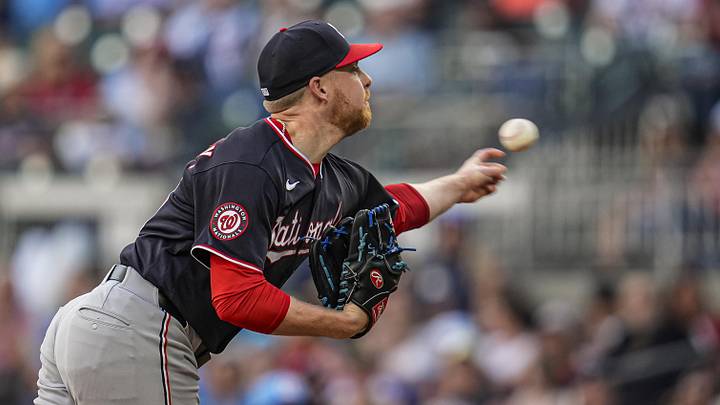
On Tuesday, Richard Lovelady secured a save against the New York Mets in the Nationals 9-6 win. Lovelady was emphatic as he ended the game against his former ball club, who designated him for assignment five times in the past calendar year.
So far this season, Lovelady has pitched extremely effectively with the Nationals. In 15 and one third innings pitched, he has a 1.76 ERA and four saves. He has become arguably the Nationals preferred option as a closer, splitting the role from Gus Varland. After being traded for a little over a month ago when the team was enduring bullpen issues, Lovelady has been awesome.
Lovelady has acheived his success in an unconventional manner. First, Lovelady's primary pitch is not a fastball, but his sweeper. He throws the pitch 44 percent of the time compared to his sinker 29 percent of the time and his four seam fastball 20 percent of the time. He does not overwhelm batters with his stuff or velocity. His sweeper is only about 82 miles per hour, while his fastballs are about 91.5 miles per hour. His sweeper, though, has above average movement, averaging 1.1 inches more break compared to other lefties and 1.5 inches more drop.
Lovelady's results are also not indicative of a en elite reliever. He strikes out batters only 20.6 percent of the time which is in the 38th percentile of Major League pitchers and he walks batters 14.4 percent of the time which is in the 8th percentile of major league pitchers. This formula is not conducive to success. He gives free passes and does not have the ability to prevent batters from putting the ball in play.
However, one skill that Lovelady does have is the ability to induce ground balls. 51.6 percent of batted balls against Lovelady are hit on the ground, which is well above average. It's hard for opposing teams to do damage against Lovelady when their contact mostly stays in the infield. Moreover, Lovelady can correct for his propensity to walk batters by generating double plays. In addition to this, hitters generally do not make hard contact against Lovelady as his hard hit and barrel percentage are both well above average.
Richard Lovelady does not have the stuff that one traditionally expects elite relievers to have. However, he is able to limit hard contact. As long as he continues to do this, he will be a solid option for the Nationals to close out their ball games and could be a valuable trading chip for the team at the deadline.
 Add us as a preferred source on Google