

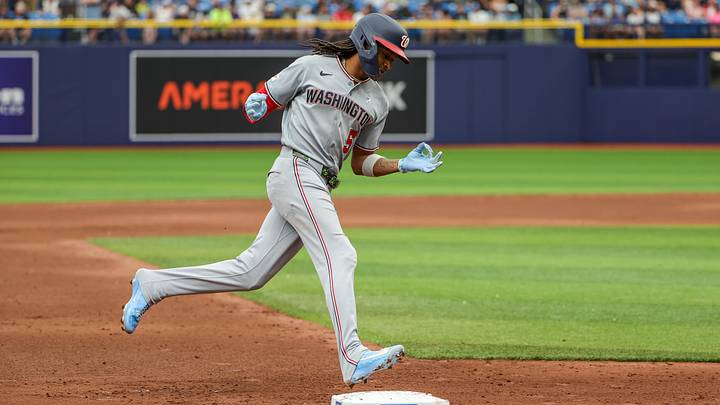
Nobody would have expected the Nationals to perform this well at this point in the season. The team has not made the postseason since winning the World Series in 2019, and over the years, they have traded away all of their core players for significant packages that have become the Nats current core of young stars.
As well as some parts of their return packages (like MacKenzie Gore) have been used to build out their farm system, which brings us to where we are now in a debate over whether the Nationals should be buyers or sellers at this year's trade deadline.
CJ Abrams, one of the two MLB-ready pieces in the return package for Juan Soto from the San Diego Padres, is having a monster season. Abrams is batting to a .286 average, a .896 OPS, with 17 homers and 57 RBI. To top that off, he is currently on track to be voted into the All-Star Game as a starter, with James Wood also having a high likelihood of being voted in as a starter.
At the beginning of the season, I anticipated CJ would be traded at the deadline, especially since he was arbitration-eligible at the end of the season. We know he'll want to get paid what he is worth, and not the $4.2 Million he is getting paid this season. The Nationals have not been paying their players because they have not been in contention, but now they are.
The Nats are in an interesting spot when it comes to the debate over whether to buy or sell at the deadline. On one hand, the Nationals have little to no shot at winning it all this year, but they do have a shot at making it to the postseason. The team has such a young core, so early in their careers, that a couple of them are potential perennial all-stars in CJ and James Wood.
I do think the Nats need to do a little buying, and a little selling.
The argument for buying
The Nationals, and every team, want to win so badly, but not every team has the power or talent to compete every year. The Nationals, as of right now, are somewhere in between. They could use an all-star pitcher or two in their rotation, because that is what you need to do in order to compete.
The Nationals have a pretty expansive farm system, so even trading two or three prospects in their top 30 for a pitcher whose contract is expiring at season's end might be beneficial if the team is confident they can make a push for the pennant. The Nationals can build excitement among their fan base and the Metro-DC area if they make a push for October.
The argument for selling
I mentioned that the Nationals are somewhere in between being buyers and sellers. Foster Griffin is having a fantastic year. Currently owning an 8-2 record with 8.8 strikeouts per nine innings, and a 3.15 ERA. With Griffin's contract expiring at year's end, and if the Nationals don't make the postseason, he might want to sign elsewhere.
On the other hand, if the Nats do make a postseason push, he will be a big reason why they do, and he may want a big-money contract over multiple seasons that the Nats may not want to pay unless, by some miracle, the Nats win the World Series. The Nationals can't go wrong with buying or selling him, because selling Griffin, might get the team a worthwhile return package of prospects, building the future of the team
The verdict
This debate is interesting, and I don't know what will happen until we approach the trade deadline, and only then will we have an answer. The Nats can win big with either decision; the question is, will it be this season, next season, or several years down the line?
 Add us as a preferred source on Google