

As the Nationals offseason gets into gear, one of the biggest questions facing every team is how to approach their players eligible for arbitration. If you're new to baseball financials, MLB teams have the playing rights for their players, or what we call "team control," until they reach six years of Major League service. They're typically paid the minimum MLB salary until they either reach three years of service or are in the top 22% of service time among those between two and three years (we call that the "Super 2" threshold). A Major League year of service is 172 days, though a player spending more than that on an active roster or MLB injured list in a season cannot accrue more than one year of service.
From that point until they reach free agency, those players are eligible for salary arbitration. That process entails a player's camp and his team negotiating on a salary for the upcoming season. If they agree on a figure, he signs the contract. That's called avoiding arbitration. If they never come to an agreement, each side submits a concrete figure to a panel of independent arbitrators, who hear arguments from both sides and decide which figure to award the player--they must firmly rule in favor of either the player or team, and there is no in-between sum that can be awarded.
Teams typically prefer to avoid going to arbitration with their players as often as possible. It can be a disenchanting experience for a player they would often like to retain to hear representatives of the team go in front of a panel and explain why they believe said player's performance isn't good enough for them to earn the salary they've requested. The sums that are gone to arbitration over are usually relatively menial to a team's payroll, too--Corbin Burnes spoke with the media before the 2023 season about how his relationship with the Brewers was negatively impacted after they took him to arbitration over a $740,000 salary discrepancy.
If a team believes whatever sum a player would earn either by arbitration or avoiding it would be more than they are willing to pay, they have until about three weeks after the conclusion of the World Series to decide not to tender that player a contract. "Tendering" just means the team agrees to give a player a contract, not that the terms of said contract have been agreed upon. Any player not tendered a contract becomes a free agent.
The Washington Nationals have eight players on their roster eligible for arbitration this year. Most are unlikely to see large raises, but some might be candidates for non-tendering. All arbitration salary projections in this column are provided by Darragh McDonald and Matt Swartz at MLB Trade Rumors.
Which Nationals players are eligible for arbitration?
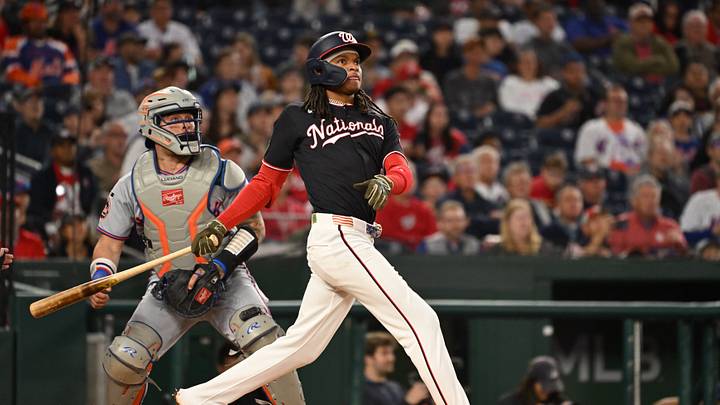
The most prominent figure on the Nationals this year eligible for arbitration is star shortstop CJ Abrams. CJ, with 4 years and 130 days of MLB service, enters his second year of arbitration eligibility this offseason. Last offseason, he agreed to terms on a $4.2 million contract on the day of the arb deadline, and figures to receive a big raise for 2027.
Abrams is projected for a $10.2 million salary in 2027 following a 2026 campaign that saw him earn his second All-Star selection and go 30/30 for the first time in his career. His poor defense at the shortstop position, and subsequent discussions about a new position going forward, is unlikely to have a negative impact on that figure. Abrams hit .261/.336/.497, and was the second-best offensive producer at short in the National League. It's possible CJ is extended on a multi-year contract this offseason, which would either be appended onto whatever agreement is made for 2027 or would overwrite it entirely.
Then there's, to put it bluntly, everyone else. Jacob Young is an interesting case. Entering his first year of eligibility, JY's coming off the best offensive season of his career. Typically regarded as a glove-first center fielder, the 27-year-old hit 10 home runs and raised his OBP over 20 points from last season. He would once again be a Gold Glove candidate in center field if Pete Crow-Armstrong didn't exist out there.
Everyone else on the list is a pitcher. Josiah Gray enters his third and final year of eligibility, but isn't much of a candidate for a considerable raise (in the modern game, players' salaries effectively never go down in arbitration). After making $1.35 million in 2024, Gray underwent Tommy John surgery in July of that year. The recovery process was incredibly slow, and he and the team agreed upon the same figure for 2025. MLBTR projects him for a $250K pay bump going into his final year of team control after he finally broke back into the big leagues with 4 scoreless innings in September.
Richard Lovelady is the first real nontender candidate. In October last year, he signed a split contract with the Mets that would see him earn $1 million while in the majors and $350 thousand while in the minors. The Nats claimed him off waivers in January, then lost him back to the Mets in March, before getting him back again in April. He missed nearly three months with a triceps strain, but wasn't all that great when he was pitching--in 38 appearances, the 30-year-old lefty had a miserable 4.1 K-BB% and was below replacement level. MLBTR projects his salary would increase to $1.7 million in arbitration, but it's more likely the team doesn't tender him a contract and he hits the open market.
Entering his second year of arbitration, it's been one setback after another for 28-year-old lefty Ken Waldichuk. Once a vaunted prospect for the Yankees, he tried to get his footing as a starter in Oakland, but needed Tommy John in 2024. After bouncing from Atlanta to Tampa Bay to Washington this past offseason, he made just five appearances as a multi-inning reliever with the Nats this year before requiring a second surgery. Waldichuk made $825,000 in 2026, and is projected to make $1 million through escalating arbitration in 2027. Time will tell if the Nationals are willing to keep him on the secondary roster through the offseason.
Jake Irvin is two years removed from a 2024 season that saw him make 33 starts to solid enough numbers. He posted 2.0 fWAR that year, and while his 2025 season was a brutal downturn where he was one of the worst full-time starters in baseball, his pedigree still enabled him to sign a $2.8 million contract for 2026.
Irvin's now 29, 30 this upcoming season, and missed 56 games in 2026 with a shoulder strain. He took on a diminished role when he was pitching, averaging fewer than 5 innings per appearance, and while his strikeout rate increased, so did his walk rate. He finished the year with a 5.48 ERA in a little over 100 innings. The Nationals will still need guys to eat innings in 2027, so it's not unthinkable that Irvin receives a contract, but it remains to be seen if the team will want him to do that at the $3.4 million figure he's projected for.
Lefty Mitchell Parker has followed a similar trajectory to Irvin. This will be his first year of eligibility, as he's projected to fall into the Super 2 class. His rookie season in 2024 was solid enough, throwing 151 innings to a 4.29 ERA and 3.85 FIP. That netted him 2.5 fWAR. Much like Irvin, Parker completely imploded last year, though, comfortably settling into a bottom 3 starter spot in the sport. He barely struck out 100 batters despite qualifying as a starter and held a 5.68 ERA.
The team tried to figure out what to do with him ever since. After starting the year in Triple-A, he came up as mostly a mop-up reliever, throwing just under 40 innings in 22 relief appearances. That resulted in a 6.58 ERA and 4.50 xFIP before Parker hit the shelf at the end of June, and at the end of July it was announced that he had undergone elbow surgery. His projected $1.1 million figure isn't much higher than the minimum, but for an injured swingman who hasn't been productive while on the field, he's not going to be guaranteed a spot on the 40-man roster--players cannot be on the injured list during the offseason.
The final arbitration candidate is right-handed reliever Jake Bird. The team acquired him at the trade deadline as part of the package that sent Luis García Jr. to the Yankees. The team evidently hoped to unlock something in the 30-year-old veteran right-handed reliever, who was running a 5.93 ERA in 30 appearances with New York before being traded. His strikeout rate did actually rebound, as he got a brief 8-game stint with the MLB squad and posted a 3.24 ERA with a 24.2 K-BB%. That fell to 19.4% in 9 appearances at Triple-A Rochester.
Bird, 31 next year, is now out of minor league options. He'll likely be tendered a contact, as he's projected for a $1.3 million salary and the team evidently saw something in him, but if the team wants to take him off the MLB roster at any point, they'll be required to pass him through outright waivers, at which point he can be claimed by any other team that is willing to take on the remainder of his salary and guarantee him a roster spot.
Will there even be contracts to tender?
The non-tender deadline, the point at which a team must make their final decisions about which players will be tendered a contract, is the 21st of November. It will likely continue to be business as usual until the end of the first day of December, when the current MLB collective bargaining agreement expires. That will almost inevitably result in a lockout, and all dealings between team front offices and players will come to an immediate halt until a new CBA is agreed upon by both sides.
The Nationals will still have to decide to which players they will be tendering contracts. If the ensuing lockout is short, the deadline to exchange concrete salary figures between the team and the camps of arb-eligible players will be the 8th of January. If the lockout drags on, only time will be able to tell. It's basically unthinkable that most or all of the 2027 season will be missed; the lockout is a leverage play by MLB ownership, but the longer it drags on, the less sympathetic fans will be to either side's cause.
Nobody really knows how much baseball there will be in 2027, or what the exact timeline will be. All we can do is wait and see and, in our case, keep going like nothing's wrong. We all need a little bit of a sense of normalcy these days anyway.
 Add us as a preferred source on Google